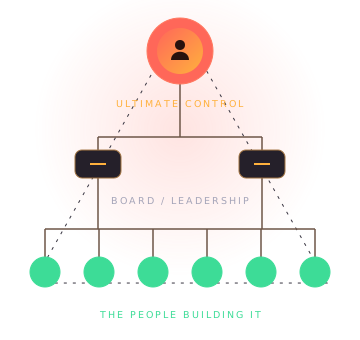
You were recruited with a mission. The org chart tells a different story — and it's all on the record.
A mission lives or dies by its structure. Here are four things you were told, against what the public filings and charters actually say.
Six labs. Thousands of brilliant people. One apex of control each.
Each diagram maps governance power, not headcount of effort. The wide grey base is the workforce — the people who actually build the systems. The narrowing layers are where decision authority concentrates. The glowing apex is whoever, by votes or ownership, can override everyone below. The base is wide because the talent is many. It's grey because their governance vote is zero.
Change the logos and the pyramid is identical. The variable isn't how nice the founder is — it's that in every single org, no one who builds the technology has any structural power over what it becomes. You are the broadest, most capable layer on the chart, and the most powerless.
Reform is possible — but only with specific, binding changes. Open any lab to see exactly what it would take.
Good intentions don't survive a cap table. These are the structural fixes — not vibes, not pledges — that would actually move each lab from "trust us" to "you don't have to." Tap to expand.
Each fix list is a structural prescription, not a claim that the lab has agreed to any of it. They describe what would make the mission enforceable rather than optional.
The catch they're counting on: the machine doesn't run without you.
A founder with controlling votes has the authority. But authority isn't capability. The model doesn't train itself. The cluster doesn't wire itself. The eval doesn't get quietly softened by the board — it gets softened by someone with your job title, on a deadline, who decided not to make it weird.
Concentrated power at the top is only as strong as the consent of the talent underneath it. You're not a cog in this machine. You're the fuel. And fuel can choose where it burns.
If the structure already guarantees that they decide and you execute — ask honestly: on the day the system holds decisive power, whose values get to ship?
How to know — from your own desk — that the mission already lost to the machine.
None of these require leaked documents. If you're nodding at three or more, you have your answer.
The long-term plan is a secret
Leadership narrates quarterly capabilities for hours but goes vague the moment you ask what they'd actually do at decisive advantage. Opacity about the endgame is the endgame.
Safety is downstream of shipping
Eval thresholds move to fit the launch date, not the other way around. "We'll address it in the next version" becomes the permanent answer.
Dissent is "not a culture fit"
The people who raised structural concerns are gone, sidelined, or silent — and non-disparagement clauses did the rest. You learned to keep your doubts in DMs.
The charter keeps getting "evolved"
Every restructure is framed as maturity. Each one moves power toward the center and money toward the cap-free top. Mission language survives; mission control doesn't.
You comfort yourself with "better us than them"
The race justifies everything. But "we must win so the bad actor doesn't" is exactly what the bad actor's engineers tell themselves too. It's the universal solvent for conscience.
No one outside the building can say no
No regulator, no trust with real teeth, no electorate. The only check on the most powerful technology in history is the temperament of people you've watched change under pressure.
You have more power than the org chart admits. Here's how to spend it.
This isn't a call to quit in a blaze of glory and change nothing. It's a call to recognize that talent is the one input these labs cannot buy a substitute for — and to spend that leverage before the window closes.
Demand the endgame in writing
Ask leadership — on the record — what the company will do at decisive advantage, and who decides. Organize so the question can't be dodged. The refusal to answer is the answer.
Protect the people who speak
Back whistleblower protections and the right to warn. Refuse non-disparagement clauses that trade your conscience for vested equity. A structure that punishes truth-telling is telling on itself.
Make the brakes real
Push for binding, externally-verifiable checks: independent evals with teeth, a trust whose thresholds are published, deployment gates a founder cannot override. "Advisory" is not a safeguard.
Build the alternative
The fix isn't better people in a broken structure — it's a structure that can't be captured: nonprofit-controlled, progressively decentralizing, with a real kill switch. Take your talent somewhere it compounds for humanity, not a cap table.
There is a design that wins capitalism while making monopoly structurally impossible — capped returns, capital decoupled from governance, founder power that mathematically decays, and an open-source poison pill if leadership is ever captured. See the blueprint →
History won't ask whether you wrote good code. It will ask whose power you served while you did.
You don't have to believe your leaders are evil. You only have to believe what their own charters say: that when the most powerful tool ever built comes online, a tiny, unaccountable few will decide what it does — and you will have built it for them. That's not a conspiracy. It's the org chart. The good news is the org chart runs on you.
We're not really asking you to reform a captured structure. We're asking you to join a coherent one.
Every pyramid above keeps power at the apex forever. A Coherent Vehicle does the opposite: it starts centralized to gather energy, then is structurally forced to hand power outward as it grows. Here is how it actually operates — the same blueprint from the power map, drawn as a living system.
The Core can't be bought
A nonprofit foundation sits above everything, holding the IP and ultimate votes. No dividends, so no gravity of greed.
The Engine moves at startup speed
A PBC raises billions and ships fast — but is legally bound to weigh public benefit, shielding you from "profit-over-alignment" pressure.
Returns are capped
Investors get economic upside to a ceiling, then excess flows back to the Core. They capture the exhaust; they never touch the wheel.
Power decays outward
Past set scale milestones, founder votes mathematically decay and quadratic voting hands governance to the ecosystem. Decentralization is hardcoded, not promised.
Power starts at the apex and stays there forever. You build; they decide; the structure protects them from you.
Power starts centralized to launch, then is forced to dissolve into the ecosystem. It wins capitalism by making monopoly structurally impossible.
If you're going to give the best years of your career to building god-tier technology, give them to the one vehicle engineered so that no single person — not even its founder — can ever own the result. See the full Orgoneism blueprint →
Sources
Governance and ownership facts as of late 2025 / early 2026. Concentration is an editorial reading of public filings — directional, not precise.
- OpenAI — "Our Structure" & the Nov 2023 board removal & reinstatement of Sam Altman. openai.com/our-structure · en.wikipedia.org/wiki/Removal_of_Sam_Altman_from_OpenAI
- OpenAI's 2025 conversion to a Public Benefit Corporation under the OpenAI Foundation (no return cap). openai.com/index/evolving-our-structure · nbcnews.com
- Twelve former OpenAI employees' amicus brief; Musk v. Altman (verdict May 2026). en.wikipedia.org/wiki/Musk_v._Altman · technologyreview.com
- Anthropic — "The Long-Term Benefit Trust." anthropic.com/news/the-long-term-benefit-trust
- Analysis of Anthropic's charter "failsafe" — stockholder supermajority can amend/dissolve the Trust. ailabwatch.org/blog/anthropic-certificate-of-incorporation · lesswrong.com
- Meta dual-class structure — Zuckerberg ~13% economic / ~61% voting. citizen.org · ainvest.com
- DeepSeek ownership — Liang Wenfeng ~84% via holding entities; spun out of High-Flyer. en.wikipedia.org/wiki/DeepSeek
- xAI acquires X (Mar 2025); Musk ~59% of the combined entity. cnbc.com · fintechweekly.com
- Google DeepMind safety governance — AGI Safety Council & Responsibility & Safety Council (advisory). deepmind.google/responsibility-and-safety
- Approximate workforce figures: OpenAI ~4,500→8,000 (2026); Anthropic ~3,000–5,000; DeepMind ~6,000; Meta Superintelligence Labs ~3,400; xAI ~1,200. saastr.com · engadget.com · builtin.com · time.com